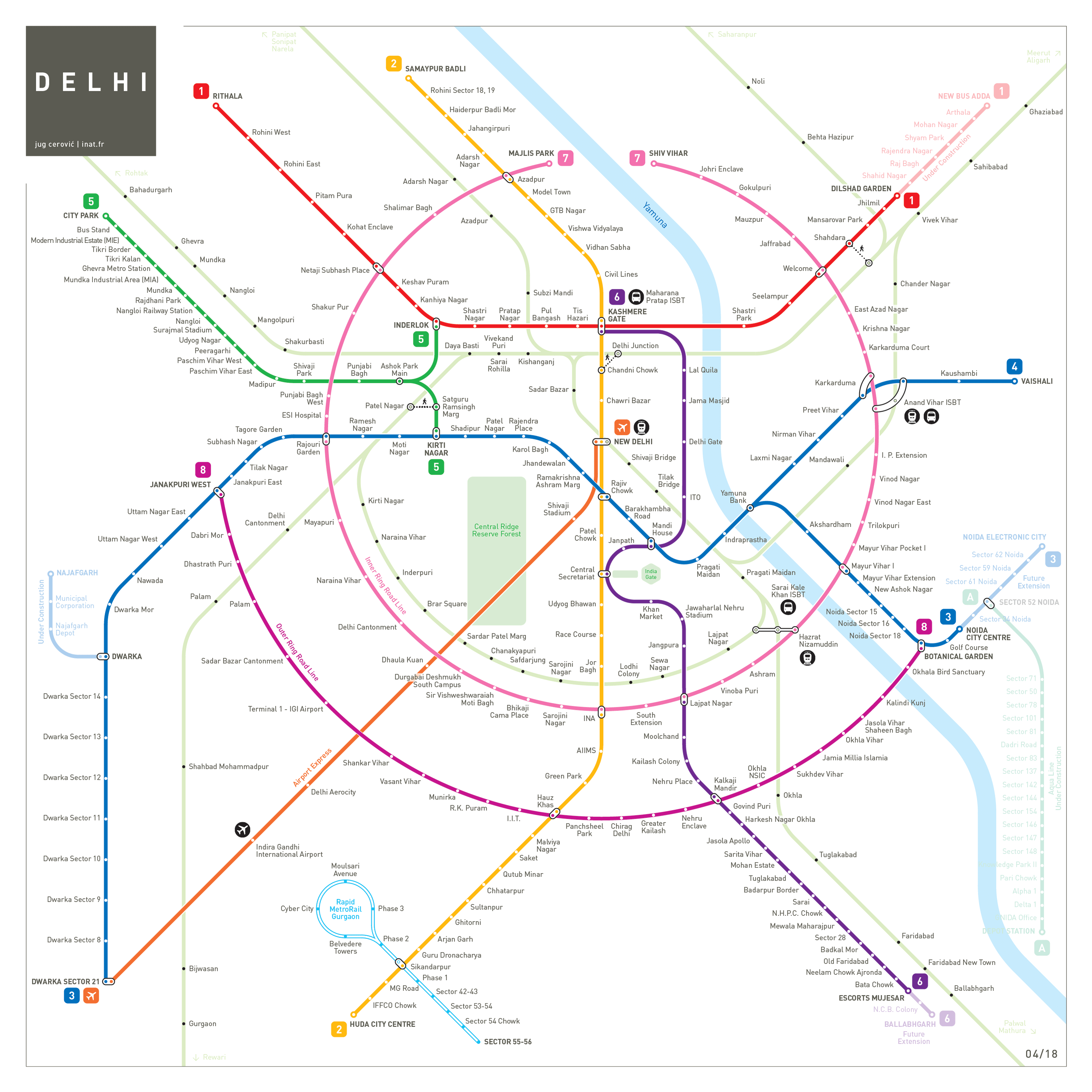
Delhi Metro Route Map
Complete route map of all Delhi Metro lines for easy navigation and trip planning.
Navigating the Heart of India's Capital — your complete guide to the Delhi Metro network, lines, timings, and tips for a seamless commute.
India's energetic capital city of Delhi is renowned for its busy streets, varied culture, and lengthy history. The demand for pleasant and efficient transit increases as a city expands. For millions of people who commute every day, the Delhi Metro is a lifeline and a marvel of contemporary infrastructure. The system is split into multiple color-coded lines, each serving a distinct set of locations and landmarks.
The Delhi Metro consists of several lines, each distinguished by unique color coding. These lines interconnect different parts of Delhi and its surrounding areas, making travel convenient and efficient.
Rithala to Shaheed Sthal (New Bus Adda) — The first line of Delhi Metro connecting North Delhi with Ghaziabad in Uttar Pradesh, passing through densely populated areas.
Samaypur Badli to HUDA City Centre — Passes through Delhi's key business districts and historic areas including Chandni Chowk. Connects to Gurugram in Haryana.
Noida Electronic City to Dwarka Sector 21 & Vaishali to Yamuna Bank — One of the longest and busiest lines, connecting Delhi with Noida and Dwarka.
Inderlok/Kirti Nagar to Brigadier Hoshiyar Singh — Primarily serves West Delhi region and acts as a feeder line for dense residential areas.
Kashmere Gate to Raja Nahar Singh (Ballabhgarh) — Connects Central Delhi to Faridabad district. Known for connectivity to Red Fort and Humayun's Tomb.
New Delhi Railway Station to Dwarka Sector 21 — Specially designed for faster connectivity to Indira Gandhi International Airport with premium features.
Majlis Park to Shiv Vihar — Known for its 'Ring' structure, almost encircling the city, providing interconnectivity between several radial lines.
Janakpuri West to Botanical Garden — Provides direct connectivity between West Delhi and Noida, also connects to Domestic Terminal of Delhi Airport.
Dwarka to Najafgarh — Serves as an extension connecting the outer regions of Dwarka with Najafgarh.
Noida Sector 51 to Depot Station — Operated by Noida Metro Rail Corporation, connects various sectors of Noida integrated with Delhi Metro network.
Complete route map of all Delhi Metro lines for easy navigation and trip planning.
Quick reference for all Delhi Metro lines with their lengths and routes.
| Metro Line | Length (KM) | Route |
|---|---|---|
| Red | 34.6 | Shaheed Sthal – Rithala |
| Yellow | 49.3 | Samaypur Badli – HUDA City Centre |
| Blue | 56.6 | Dwarka Sector 21 – Noida Electronic City |
| Green | 26.3 | Inderlok – Brigadier Hoshiyar Singh |
| Violet | 46.6 | Kashmere Gate – Raja Nahar Singh |
| Orange | 20.0 | New Delhi – Dwarka Sector 21 |
| Pink | 57.5 | Majlis Park – Shiv Vihar |
| Magenta | 37.4 | Janakpuri West – Botanical Garden |
| Grey | 5.19 | Dwarka – Dhansa Bus Stand |
Everything you need to know about fares, operating hours, and amenities available across the Delhi Metro network.
Tokens and smart cards are available for purchasing tickets. Tokens are good for one-time trips, while smart cards offer fare discounts and hassle-free travel for frequent commuters. Fares are determined by distance traveled and can be checked on the DMRC's official website or at stations.
Operating hours range from early morning (~5:00 AM) to around midnight (~11:30 PM), with trains running every 2-5 minutes during peak hours. Exact timings vary by line and day of the week — check the latest schedule for early morning or late night travel.
Air-conditioned carriages, clean stations, escalators, elevators, and amenities for passengers with disabilities. Restrooms, food stands, and ATMs are available at most stops. The entire network is designed for barrier-free access.
Each station is equipped with security personnel, CCTV surveillance, and baggage screening. Dedicated Women's Coaches in each train ensure a safer travel environment for female passengers.
The Delhi Metro connects prominent landmarks like Qutub Minar, Red Fort, and Akshardham Temple. 'Tourist Cards' provide unrestricted travel for a limited time — ideal for visitors wishing to explore the city.
Make the most of your Delhi Metro experience with these practical tips.
Always check the last train's timing for your return journey to avoid getting stranded.
Keep an eye on the electronic display boards for train arrival times, platform numbers, and destinations.
Follow the directional signs and maps at stations to navigate between different lines and exits.
Be mindful of peak hours — usually 8-10 AM and 5-8 PM on weekdays. Plan accordingly for a comfortable ride.
The Delhi Metro holds several special facts and achievements that make it stand out not just in India, but on the global stage.
India's first modern public transportation metro system, revolutionizing urban transit in the country.
First railway project in the world certified by the UN as a Clean Development Mechanism project, earning carbon credits.
Daily ridership of over 2.7 million passengers prior to the pandemic, showcasing its integral role in daily life.
Uses solar power at several stations and depots with plans to increase renewable energy usage across the network.
Stations adorned with artworks, murals, and installations reflecting India's rich cultural heritage and contemporary art.
Incorporates regenerative braking systems, modern signalling, and advanced telecommunication networks.
Stations like Jawaharlal Nehru Stadium and Mayur Vihar Extension noted for unique and innovative designs.
DMRC collaborates with international metro systems and institutions for technological and operational advancements.
Quick answers to common questions about traveling on the Delhi Metro.