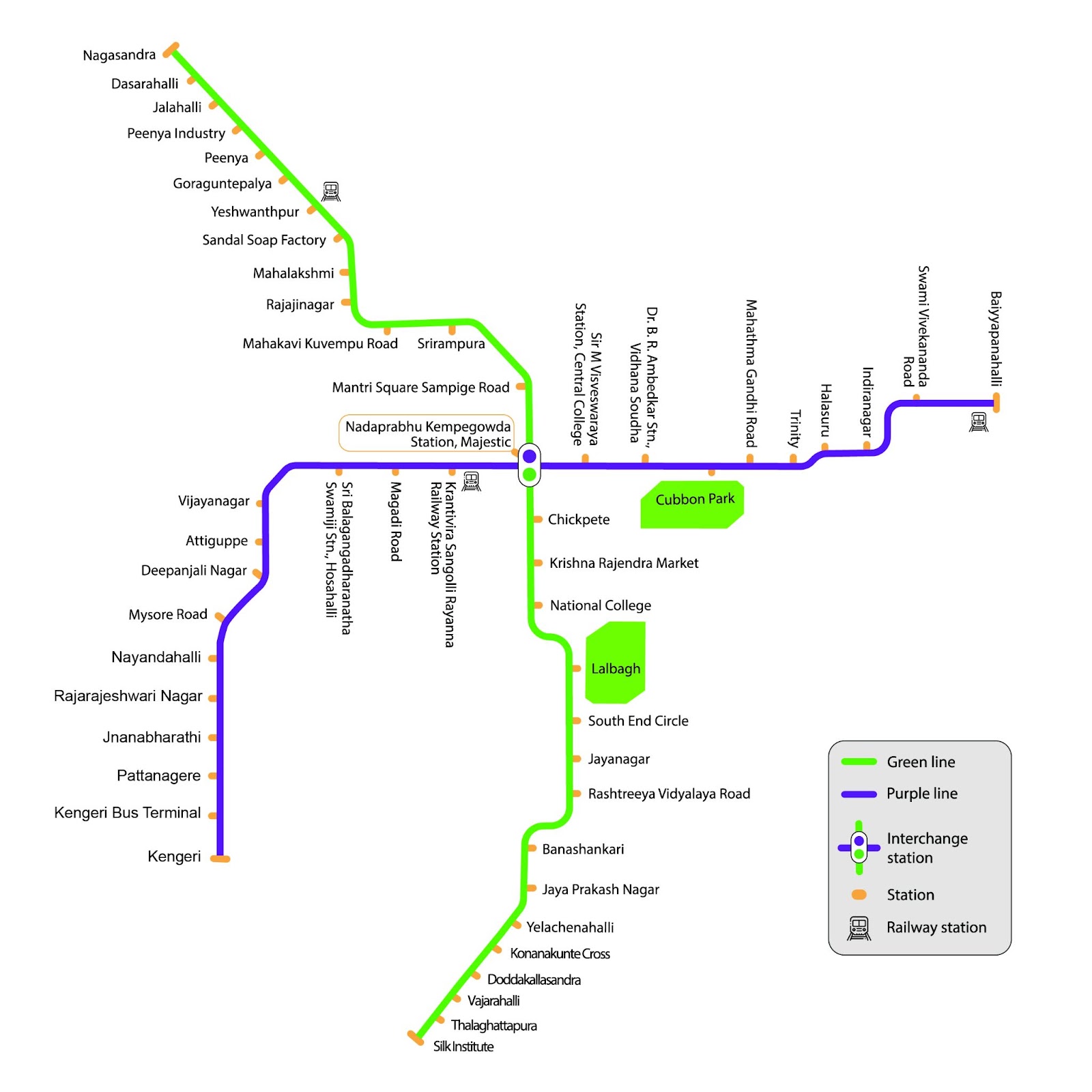
Namma Metro Route Map
Complete route map of all Namma Metro lines for easy navigation and trip planning.
Revolutionizing Bengaluru's transportation landscape — your complete guide to Namma Metro's network, lines, expansions, and impact on the city.
Bengaluru's proposed rapid transport system, Namma Metro ("Our Metro" in Kannada), was designed to address the city's increasing population and growing traffic issues. Introduced in 2011, it provides a modern, efficient, and sustainable form of public transit.
Namma Metro currently operates two lines, each distinguished by unique color coding. These lines interconnect different parts of Bengaluru, making travel convenient and efficient across the city.
Whitefield to Challaghatta — 42.17 km covering 37 stations. Connects key areas like MG Road, Indiranagar, Kempegowda Interchange, and Mysuru Road.
Nagasandra to Silk Institute — 30.3 km covering 29 stations. Connects CBD, Jayanagar, Rajajinagar, meeting Purple Line at Kempegowda Interchange.
Complete route map of all Namma Metro lines for easy navigation and trip planning.
Quick reference for all Namma Metro lines with their lengths, stations, and routes.
| Metro Line | Length (KM) | Stations | Route |
|---|---|---|---|
| Purple | 42.17 | 37 | Whitefield – Challaghatta |
| Green | 30.3 | 29 | Nagasandra – Silk Institute |
Namma Metro is rapidly expanding to connect more areas of Bengaluru, with several new lines and extensions in the pipeline.
Approximately 21.25 km linking south to north Bengaluru via Silk Board, RV Road, and Jayadeva Hospital. This line will significantly ease north-south connectivity and reduce congestion on major corridors.
Approximately 17 km via Bellandur, Mahadevapura, relieving Outer Ring Road — one of the most congested stretches in the city serving the IT corridor and tech parks.
Airport Line and Electronics City extensions have been proposed to connect Kempegowda International Airport and the Electronics City IT hub directly to the metro network, transforming accessibility for commuters and travelers.
Namma Metro has brought transformative changes to Bengaluru's urban fabric, influencing mobility, economy, real estate, and daily life.
Namma Metro bridges distant neighborhoods, reducing travel time across the city and making daily commutes faster and more reliable for millions of residents.
Metro connectivity has catalyzed commercial development along corridors, attracting businesses, retail, and employment opportunities near transit hubs.
Properties near metro stations have witnessed significant appreciation, with 15-25% premiums driving residential and commercial real estate growth.
By shifting thousands of commuters from roads to rail, Namma Metro helps reduce vehicular emissions and eases traffic pressure on key arterial roads.
Affordable and efficient transit enables access to education, healthcare, and employment for all income groups, fostering inclusive urban development.
Growing ridership reflects a cultural shift from private vehicles to public transit, promoting sustainable commuting habits among Bengaluru's population.
Metro stations serve as vibrant public spaces connecting diverse communities, fostering social interaction and cultural exchange across the city.
Namma Metro incorporates modern signalling systems, smart ticketing, real-time tracking, and energy-efficient operations driving innovation in urban transit.
While Namma Metro has achieved significant milestones, several challenges remain as the network scales to meet Bengaluru's growing needs.
Extending metro coverage to underserved areas and completing Phase 2 & 3 on schedule to meet growing demand across the city.
Integrating feeder buses, bike-sharing, and pedestrian infrastructure to bridge the gap between metro stations and final destinations.
Balancing affordable fares with operational costs, exploring revenue models through transit-oriented development and commercial leasing.
Navigating complex land acquisition processes in a densely built city while minimizing displacement and ensuring fair compensation.
Implementing smart transit solutions including contactless payments, AI-based crowd management, and real-time passenger information systems.
Optimizing train frequency, reducing headway times, and ensuring punctual service as ridership scales with network expansion.
Quick answers to common questions about traveling on Namma Metro.